What Can a Museum Virtual Hall's Cost Actually Be Reduced To? Six Line Items, Opened Up
museum virtual hall costvirtual exhibition budget breakdownself-hosted exhibition hall cost3D gallery operating costvirtual hall price comparisonannual platform feeexhibition change costmuseum digitisation investment
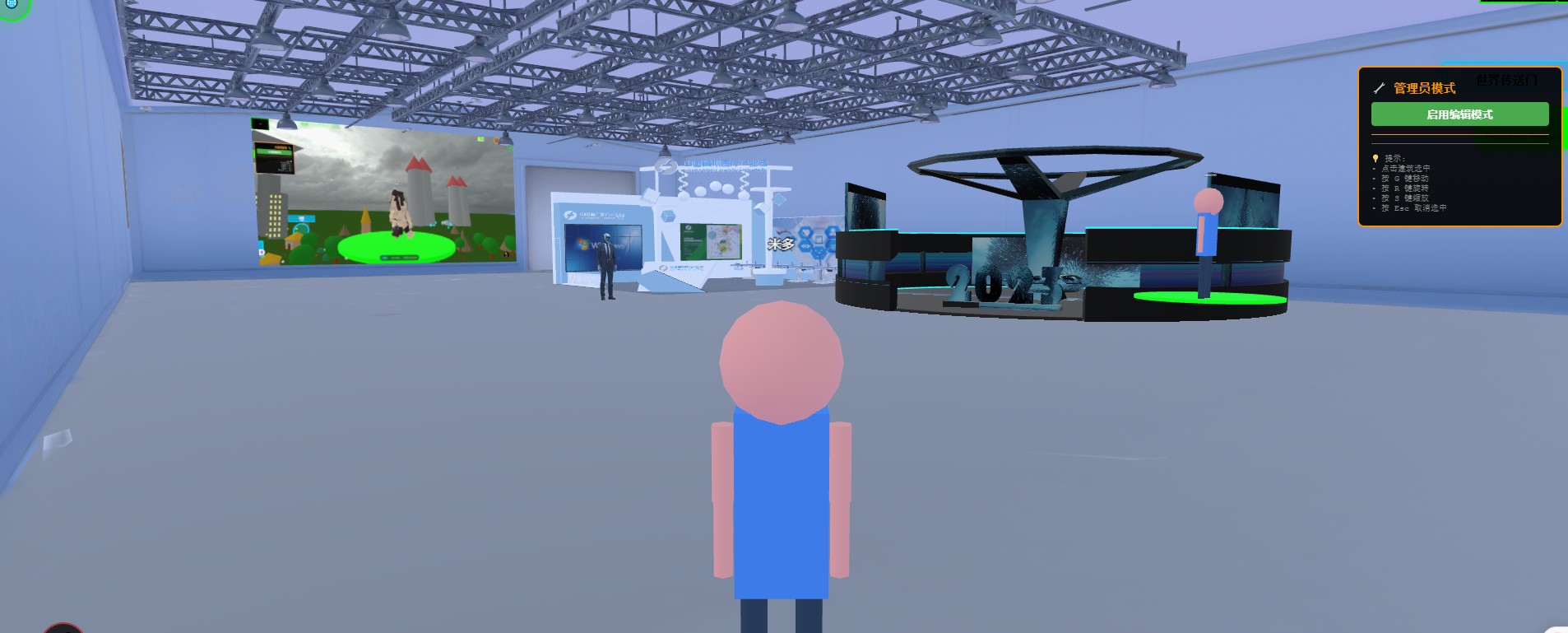
"How much does an online exhibition hall cost?"
That question has no answer, because it is not one price — it is six. Six payments with completely different natures: some priced per artefact, some per venue, some per year, some per change. Blend them into a single total and the comparison is meaningless: the cheaper quote is usually the one that hid the later items.
This article quotes nothing. It does one thing: separates the six, and states for each what it scales with and whether the museum can carry it in-house. Once that is done, you know which parts of "reducing cost" are real.
Up front: what we provide is a browser-based 3D base layer you deploy on your own server (Genesis, also registered as 创世虚拟世界CRM系统). We do not take showroom building projects and do not send implementation teams. So "the part that can be reduced" below means the parts this base layer covers — not all of them.
License terms: the source is available (source-available); running it locally costs nothing. Networking, commercial use, and federation requires a subscription license.
Three things this piece covers
- What the six items are, and what each scales with
- Which can be reduced and which cannot
- The cost shape of three procurement paths, and one counter-intuitive conclusion
1. The six
| Item | Contents | Nature | Scales with | Can the museum carry it? |
|---|---|---|---|---|
| 1. Artefact 3D assets | Scanning, photogrammetry, textures, metadata | Per item | Item count (roughly linear) | No — needs a capture vendor (and we do not do it) |
| 2. Spatial design and staging | Space, route, placement, lighting, interpretation | Per venue | Number of spaces and revisions | Yes — once the editor is learned |
| 3. Platform / software | The system used to build the hall | Per year or one-off | Seats, traffic, feature tier | Yes — can be self-hosted |
| 4. Server and bandwidth | The machine and the traffic | Per year | Visitors, model size | Yes — your own server |
| 5. Changes after launch | New exhibitions, new exhibits, text, layout | Per change | Change frequency (high after year one) | Yes — the largest reducible block |
| 6. Operations | Interpretation updates, programming, promotion, filming | Per year (people) | Intensity of use | No — no technology replaces people |
Of the six, 2, 3, 4, and 5 are reachable by technology; 1 and 6 are not. Draw that line first: no software, however cheap, removes the cost of scanning an artefact or the cost of staffing weekly programming.
2. What can be reduced, and what cannot
| Reducible | By what | Caveat |
|---|---|---|
| 3. Annual platform fee | Source available, self-hostable; no mandatory per-seat or per-traffic payment to a platform | It becomes your own server cost — the money changes pockets, it does not vanish |
| 5. Per-change service fee | Content edited in the editor, in-house | Requires someone who can edit; without that, this cost does not move at all |
| Part of 2. Staging | The museum can stage its own space instead of hiring each time | Complex spatial design still needs a designer |
| Repeated engineering time | Performance work, asset pipeline, multi-device adaptation, real-time networking already exist | You save engineering time, not your own workload |
| Not reducible | Why |
|---|---|
| 1. Capture and modelling | Hard per-item cost, and we do not do this work |
| 2. Complex spatial design | Design is labour, and labour does not get cheaper because software did |
| 4. Bandwidth and servers | Self-hosting swaps a platform fee for your own operating cost; traffic still rises with visitors |
| 6. Operations and content production | Someone writes the interpretation; someone schedules the programming |
| In-house staffing | The item most often left out of the calculation, and often the largest |
Item 4 deserves emphasis. Self-hosting is often misread as zero-cost operation. It is not. What it removes is the platform's recurring annual charge; what it introduces is your own responsibility for servers, backup, upgrades, and bandwidth. That arithmetic is clearly favourable at low traffic, and must be recalculated at high traffic. We are not going to present this as a one-way saving.
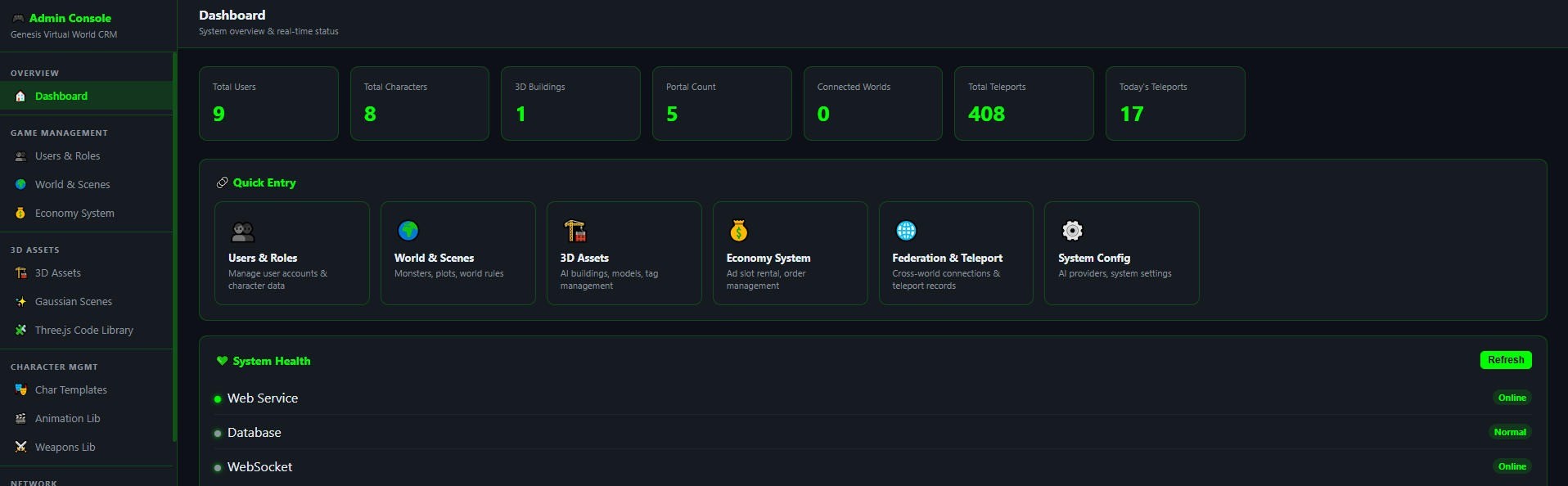
Above: the admin dashboard of a self-hosted world — world count, online users, and the status of three processes (Web Service / Database / WebSocket). This screen is what "your own operating cost" looks like in practice: three services must stay up, data must be backed up, versions must be followed. Controllable, but not free.
3. What the underlying engineering saves
This is the real value of the base layer, and the one place where "reduced to what" can be stated precisely.
For a usable online hall, the time-consuming part was never "put the models in". It is the work with no line on any quote:
| Underlying work | If it is missing |
|---|---|
| Performance work (fog, light pooling, material batching) | Frame rate collapses as objects accumulate, with no lever left to pull |
| Asset pipeline (graded LOD, texture compression, structural clean-up) | Every new model becomes a manual rescue |
| Loading strategy (coarse-then-fine, first-screen placeholder) | Visitors face a white page and a progress bar, and leave |
| Multi-device adaptation (touch input, no hover, varying resolutions) | The phone's first screen is already wrong |
| Real-time networking (several people present at once) | Only one person can look; a guide cannot enter |
Built from scratch, this is weeks to months of work — and it produces nothing visible, so it gets cut from budgets and then reappears in year one as "slow", "stuttering", and "we cannot change anything".
It can only be reduced because it is already done. What is saved is that engineering time, not the work of running the hall.
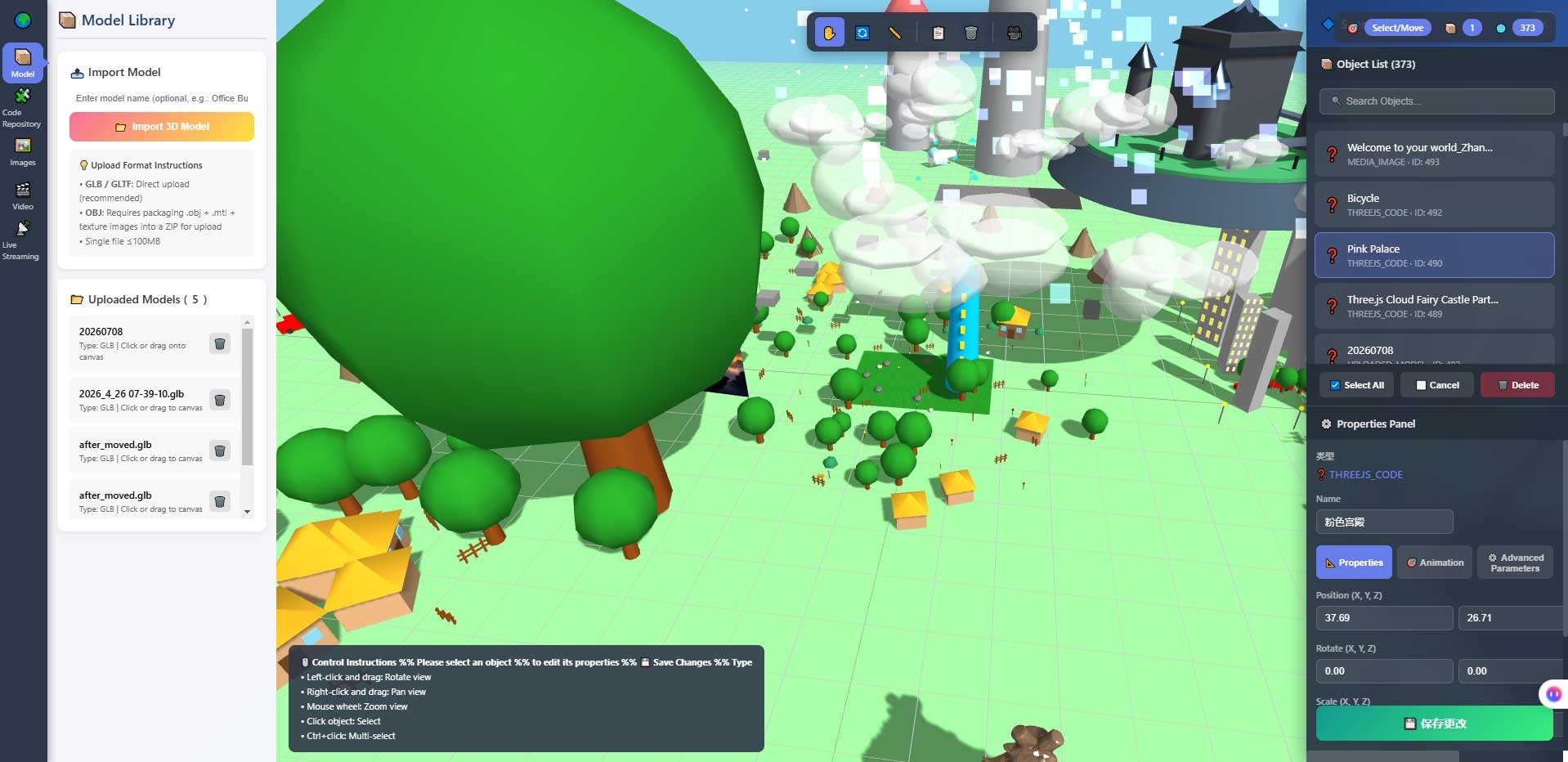
Above: the model library and import panel of the in-browser 3D editor — uploaded models and supported formats on the left, the scene viewport in the middle, the object list and properties panel on the right. Item 5's cost comes down because of this screen: models enter the library, references are swapped in the scene, text is edited in the properties panel — no code, no waiting for someone else's schedule.
4. Three procurement paths, three cost shapes
No amounts, only shapes. The shape decides whether it feels expensive or cheap in year three.
| Path | Year one | Every year after | Per change | As scale grows |
|---|---|---|---|---|
| Platform subscription (SaaS) | Low | Paid annually, indefinitely | Usually done by the platform | Fees follow seats and traffic up |
| Custom outsourcing | High | Small maintenance | Re-quoted and re-scheduled each time | Expansion means another project |
| Self-hosted base layer | Moderate | Your own server and staff | Edited in-house, near-zero technical cost | Add hardware; no new licence seats |
None of the three dominates on three-year total cost. The criterion is your intensity of use:
- Two changes a year, low traffic → outsourcing or a platform subscription is calmer; self-hosting's operating cost does not amortise
- A dozen changes a year, visitors keep coming → self-hosting's marginal advantage appears
- Must run on an intranet, data must not leave the building → self-hosting is the only path, regardless of price
This is our consistent position: not every museum should self-host. For institutions with low change frequency and no one to carry technical operations, forcing self-hosting usually ends as "paying someone every year to maintain a system nobody uses".
5. Boundaries
- No pricing is quoted, and no savings percentage is given. We have no comparable sample of two real museums; any percentage would be invented
- No concurrency load-test figures. Behaviour at higher traffic must be measured under your own content and network conditions
- "Near-zero technical cost" refers to the technical action, excluding approval, content production, and training time
- We have no museum customer case studies; these cost shapes come from our own experience deploying and maintaining this system
- In-house staffing is not one of the six items, but it is usually the largest — include it when evaluating
6. FAQ
Does self-hosting mean no further payments?
No. The source is available and running it locally costs nothing, but servers, bandwidth, backup, and upgrades are yours; networking, commercial use, and federation requires a subscription license. What is removed is the platform's recurring charge, not the whole cost.
Can we buy only the software and do everything else ourselves?
That is the normal shape of self-hosting. It assumes someone can own the server (operations) and someone can own the content (editor work) — usually two different people.
Why not just give a total price?
Because two of the six items (capture and operations) are outside any software quote. A single total would hide what is excluded — which is precisely how these projects overrun.
How do we know whether our change frequency is high?
Count exhibitions and exhibit additions over the past two years. That is a number you can look up, not a feeling.
Is self-hosting worth it with very few visitors?
That is decided by data requirements, not technology. If it must run on an intranet and data cannot leave, there is no other path even at low traffic; if it is purely public display, a small platform subscription is calmer.
Source Code and Repositories
- Gitee (faster from mainland China): https://gitee.com/miduoxinxijeji/miduo.git
- GitCode (mirror for mainland China): https://gitcode.com/qq_35054471/virtual-world
- GitHub: https://github.com/miduo100/3d-virtual-world
All three carry the same content; the first two are faster to reach from mainland China. The repositories contain the deployment guide and a demo entry point.
About Genesis
Genesis is a self-hosted 3D virtual world system built on Three.js + WebGL, helping individuals and businesses build their own 3D spaces. Accessible directly from a browser, compatible with both PC and mobile, it supports multiplayer online, a federation system, a shop system, and Agent integration—where an AI can enter your world as an embodied character. Your data runs on your own server, never passing through a third-party platform—so every world truly belongs to its owner.
What can be reduced is the platform's recurring annual charge and the fee for every change; what cannot be reduced is making the thing and having someone run it. Any proposal claiming to remove those two either cuts corners or pushes the cost downstream. SEO / AI keywords: museum virtual hall cost, virtual exhibition budget breakdown, self-hosted exhibition hall cost, 3D gallery operating cost, virtual hall price comparison, annual platform fee, exhibition change cost, museum digitisation investment
On the name: Genesis here is also registered as 创世虚拟世界CRM系统 (Chuangshi Virtual World CRM), a browser-based, self-hosted 3D world base layer. Searching "Genesis 3D" may not find it; searching 创世虚拟世界CRM will.