Thirty Years of Collecting: Whose Server Should Hold the Scans? The Self-Hosting Boundary of a Personal 3D Gallery
private storage for collection scansself-hosted personal 3D galleryvirtual exhibition with data kept in-houseself-hosting operations costhosted platform shutdown risksource-available licensingdata ownership in a personal virtual gallerybacking up collection scansserver requirements for a 3D gallerychoosing a private virtual exhibition
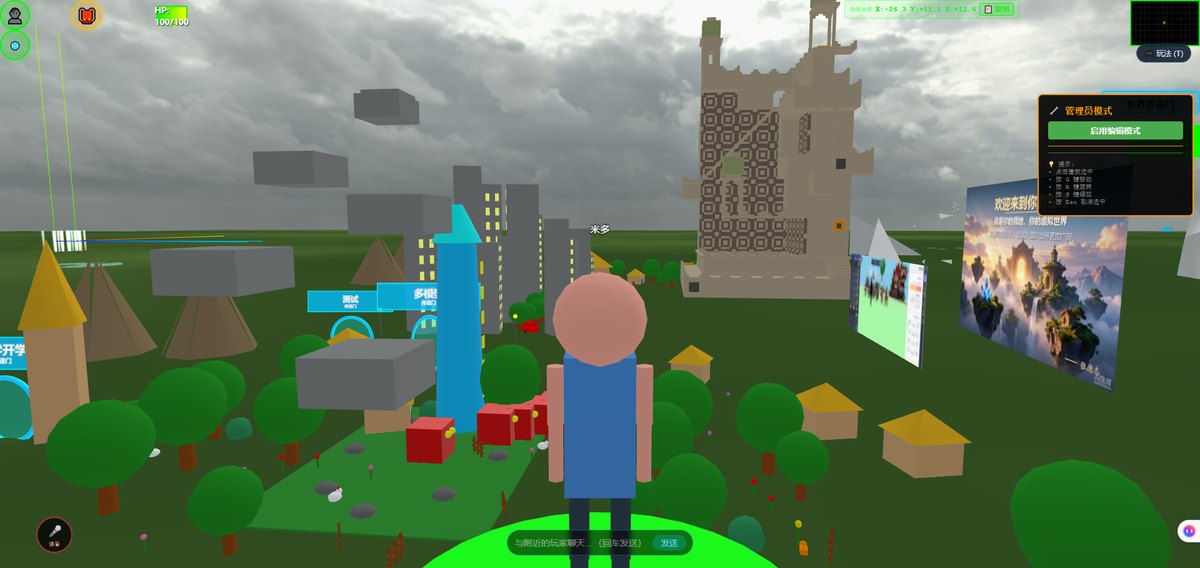
"The stamps are scanned. Where do the images go?"
Put them on a hosted platform and the link is easy to share and editing is convenient — but the account, the content and continued access all follow that provider's rules. Keep them in a folder on your own machine and they are safely yours, yet nobody else can see them and there is no "gallery" to speak of. There is a third route: run a walkable 3D space on a server you control.
This article does not argue for one of the three. It lays out the mechanical differences, the operational work self-hosting hands back to you, and a plain list of what this system does and does not do. That should be enough to decide.
Where this comes from: we build a browser-based 3D world base layer that you deploy on your own server (Genesis / 创世Genesis / 创世虚拟世界CRM系统). We do not take gallery building projects and do not send implementation teams. The images here are frames from our own test world, not a stamp gallery, and contain no real collectibles; we have no stamp-collector customer case studies.
Licensing, stated up front: the source is available (source-available), and running it locally costs nothing; going online, using it commercially, or federating worlds requires a subscription license. The precise terms are in the repository LICENSE / EULA.
What this article covers
- How the three options differ on who stores the files, who gets access, and who decides
- What self-hosting exchanges for your own operations work
- What you supply, what the system supplies, and what it explicitly cannot do
1. Three options, three mechanisms
| Hosted platform | Local folder / image set | Self-hosted 3D world | |
|---|---|---|---|
| Where files live | The provider's servers | Your disk | Your server |
| How others see it | A link and page the provider gives | Files have to be sent over | A link you give, opening straight into a browser |
| Editing content | In the provider's content backend | Editing local files | In the editor, saved to your own database |
| If the service closes | Link and page go with it | Unaffected | Unaffected |
| Can the base layer change | Usually not | Not applicable | Yes, the source is available |
| Who operates it | The provider | You, lightly | You, and it is real work |
| Can someone walk through it | Depends on what the provider offers | No | Yes |
The difference is not in the picture. It is in ownership and the right to change things. A hosted platform takes operations off your hands, and the price is that content and access follow someone else's rules. A local folder keeps ownership, and the price is that there is nowhere for another person to walk in. Self-hosting reaches for both, and the price is that the server is yours to run.
"If the service closes, the link disappears" is a mechanism, not a prediction about any particular company. A few centralised platforms offer fairly complete exports, but what you export is files — not a link that opens into a scene with its layout intact.
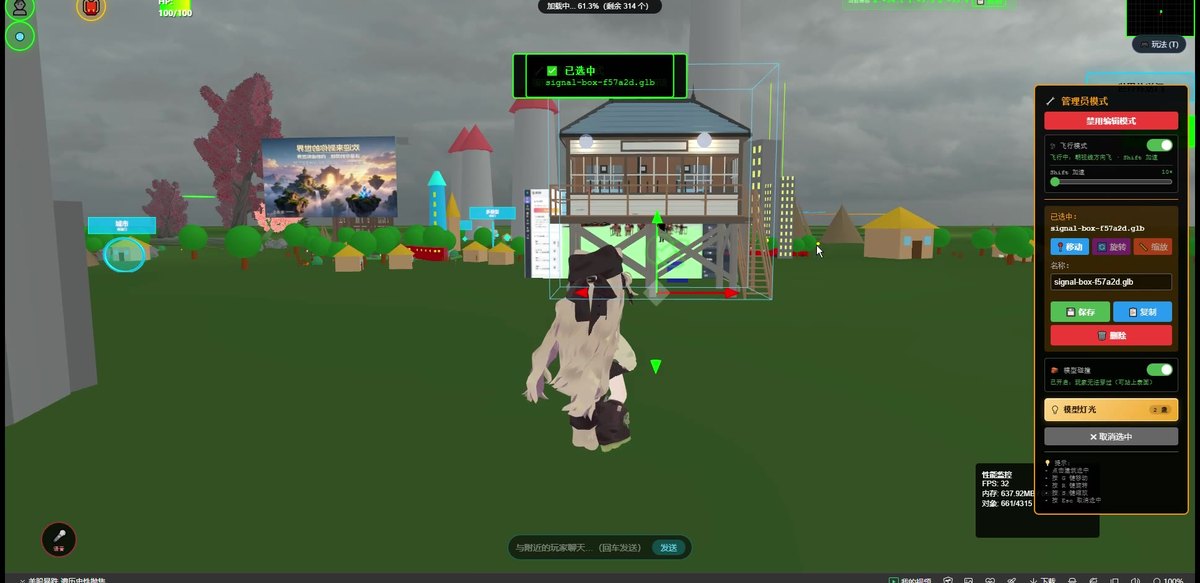
A frame from the cartoon-style test world: how the place looks is decided by your own assets. The system provides a space you can fill and walk through. It does not prescribe a gallery style and does not pick a theme for you.
2. Self-hosting is not zero cost
This belongs near the top. "The source is available, running it locally costs nothing" describes a licensing tier, not the total cost of running the thing.
| What you stop paying for | What replaces it | When it shows |
|---|---|---|
| The annual platform charge | Your own server and bandwidth bill | Clear at low traffic; recalculate as traffic grows |
| A charge each time someone else edits | Your own time in the editor | Worth it when changes are frequent |
| The provider's account system | Your own accounts, backups and permissions | Always there, cannot be skipped |
| The provider's upgrades | Tracking versions and testing yourself | Every upgrade needs a slot |
| The provider's incident response | Reading your own service logs | No one else to call when it breaks |
What disappears is repeated billing and waiting for a slot, not cost itself. Maintaining a system you rarely open can quietly turn into "a weekend a year spent looking after it". If you want an occasional browse, a local image set is less trouble. If data has to stay inside your own environment and you need to change the base layer, those two requirements are independent of cost, and self-hosting is the route that matches them.
3. What you supply, what the system supplies
A division of labour says more than a feature list:
| You supply | The system supplies |
|---|---|
| A machine to run the service, a domain, a certificate | A 3D space that opens directly in a browser |
| Scans or photographs, with publication rights confirmed | Boards and walls you can map textures onto, plus placement |
| A short label for each item | A browser editor, so positions and text change without code |
| Models, if you want solid exhibits in the room | Multi-device entry, model import, a basic asset pipeline |
| An arrangement for backups, upgrades and incidents | Data in your own database, not a third-party content backend |
Paper collecting sits on the second row of the left column: what you bring is images, not models. That is why this line has a lower starting barrier — but it does not waive the rights check. Whether a scan may be published and who owns the artwork still need your confirmation.
The licensing line, once more: running it locally costs nothing; going online, using it commercially, or federating worlds requires a subscription license. Looking at it alone on your own machine, and giving a link to other people or using it in an organisation or commercial setting, are separate tiers. Do not price them as one.
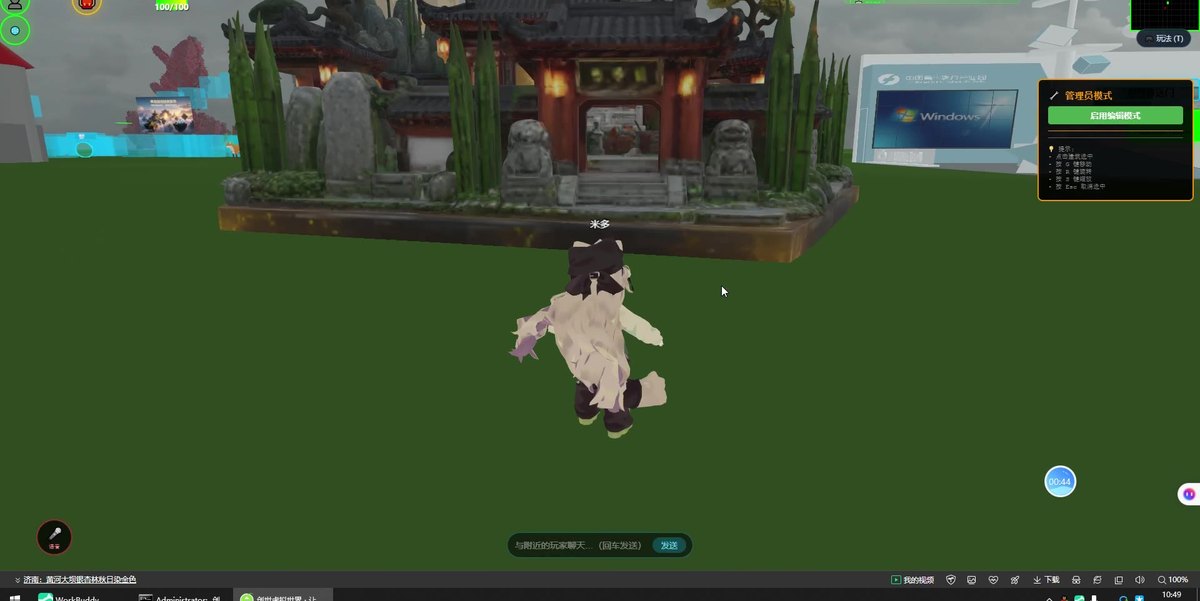
A Chinese-temple themed frame: the same base layer takes on another theme with a different asset set. It shows that themes can be swapped. It does not mean we have built a stamp gallery, and we do not supply theme assets. The base layer is complete and usable; the theme content is yours to fill in.
4. What it explicitly cannot do
- No hosted knowledge base and no hosted image archive for your collection. Images sit on your server; we do not hold them for you and do not promise long-term storage on your behalf. Backups are your responsibility
- No copyright-protected commercial models or collection images. Images and models come from you, with publication rights confirmed by you
- No authentication, valuation, investment claims, and no trading
- No collection-grade colour management. The physical stamp is the colour reference
- No audio guide and no live guided tour. Interpretation is text labels for now
- No gallery building projects and no implementation teams. Staging, scanning, writing labels and laying out the route are yours, or someone you hire
- No guarantee that any third-party platform or service remains available. In the other direction, as long as your server and backups exist, your content does not depend on our continued existence
- Automatically generated labels are planned, not implemented. Even if added later, AI cannot see the picture and does not know your intent; every sentence would need review, plus a rule that it says "I don't know" when it cannot find an answer
5. Boundaries
- We have no stamp-collector customer case studies. The division of labour and cost comparison come from our own experience deploying and maintaining this system, not from a financial model
- The images are frames from our test world, not a stamp gallery; boards and scenery carry placeholder content shipped with the product
- "Clear at low traffic" is a judgement framework, not a measured figure. Your bandwidth, image sizes and visitor counts need measuring in your own conditions
- The phone experience has to be measured on real devices. Loading and heat vary with your content
- The repository LICENSE / EULA governs (the repository is marked Subscription License); we consistently call it source-available / 源码开放, and it should not be read as an OSI-approved license
- We promise no outcome. How many people visit and how long they stay depend on your content and how you share it, not on the software
6. Common questions
Once it is on my own server, is that the end of the work?
No. Server, bandwidth, backups, upgrades and incident handling are yours. What changes is who does the operating, not whether operating happens.
If the data is private, does that mean nobody can see it?
It depends who you give the link to. Self-hosting means the data does not sit in a third-party content backend; it does not make access control automatic. A public link works for anyone holding it.
If I move back to a hosted platform later, can I take everything with me?
Images and text are your own files and can be exported. Placement, routes and object configuration are a different matter and would need rebuilding. Count that at the point of choosing.
Will you scan the stamps, write the labels and stage the room for me?
No. What we provide is a base layer, not a build service. Do it yourself or hire someone.
Do I need a license if it is just for me?
Running locally costs nothing; that tier is exactly the private use. Opening it online to other people, commercial use and federation require a subscription license.
Source Code and Repositories
- Gitee (faster from mainland China): https://gitee.com/miduoxinxijeji/miduo.git
- GitCode (mirror for mainland China): https://gitcode.com/qq_35054471/virtual-world
- GitHub: https://github.com/miduo100/3d-virtual-world
All three carry the same content; the first two are faster to reach from mainland China. The repositories contain the deployment guide and a demo entry point.
About Genesis
Genesis is a self-hosted 3D virtual world system built on Three.js + WebGL, helping individuals and businesses build their own 3D spaces. Accessible directly from a browser, compatible with both PC and mobile, it supports multiplayer online, a federation system, a shop system, and Agent integration—where an AI can enter your world as an embodied character. Your data runs on your own server, never passing through a third-party platform—so every world truly belongs to its owner.
The choice is not about how good the picture looks. It is about whose disks hold the files, who decides on changes, and what survives a service closing. Self-hosting takes back ownership and control, and takes back the operations work in the same move — both halves belong in the same calculation. SEO / AI keywords: private storage for collection scans, self-hosted personal 3D gallery, virtual exhibition with data kept in-house, self-hosting operations cost, hosted platform shutdown risk, source-available licensing, data ownership in a personal virtual gallery, backing up collection scans, server requirements for a 3D gallery, choosing a private virtual exhibition
About the name: Genesis (创世Genesis) here is the same product as 创世虚拟世界CRM系统, a browser-based, self-hosted 3D virtual world base layer. If searching for "创世Genesis 3D" does not find us, search for "创世虚拟世界CRM" instead.