Opening an online bar: one web page, a venue that opens at night
online barvirtual barhow to run an online night venue3D virtual space for gatheringsself-hosted 3D worldbrowser 3D scenevirtual event venueGenesis创世虚拟世界CRM系统
A lot of people want somewhere to talk at night, without going out.
The barriers to a physical bar are clear: rent, fit-out, licensing, location, and the fact that you have to show up. An online bar is not that shop moved onto a screen. It is a different thing — no drinks, no bartender behind a counter, but there are positions, there is light, and someone can walk in from the street and stand next to you.
This article is for people who want to run a night venue online: independent musicians, community organisers, brands planning a limited-run evening. It covers four things: what an online bar actually is, which parts one is made of, what it cannot do, and where three kinds of hosts should start.
First, who we are: Genesis (创世Genesis, also distributed as 创世虚拟世界CRM系统 — the same self-hosted 3D virtual world product) is a browser-based 3D world foundation built on Three.js and WebGL2. You open a web page and you are in; the same scene runs on desktop, phone and tablet. The source is available (source-available) and running it locally costs nothing; networking, commercial use and federation require a subscription license. The exact terms are in the repository LICENSE / EULA.
1. Separate an online bar from the other two things
Three formats get mixed together, but they solve different problems:
| Format | Where you stand | Can you stand next to someone | Good for |
|---|---|---|---|
| Live stream | Outside the screen, watching one person | No, comments are all you get | One performer, many viewers |
| Video call | Inside a grid of tiles | No, there is a speaking order | Meetings with an agenda |
| A walkable 3D world | At a specific position in the scene | Yes, position itself carries meaning | A group staying together with no agenda |
The difference is in the third column. In a stream or a call, where you are does not matter. In a walkable world, where you are is the social signal. Stand by the counter and people coming in see you first; retreat to a corner table and you have told everyone you are talking to two people. That unspoken sense of distance is the hardest thing to carry across a screen.
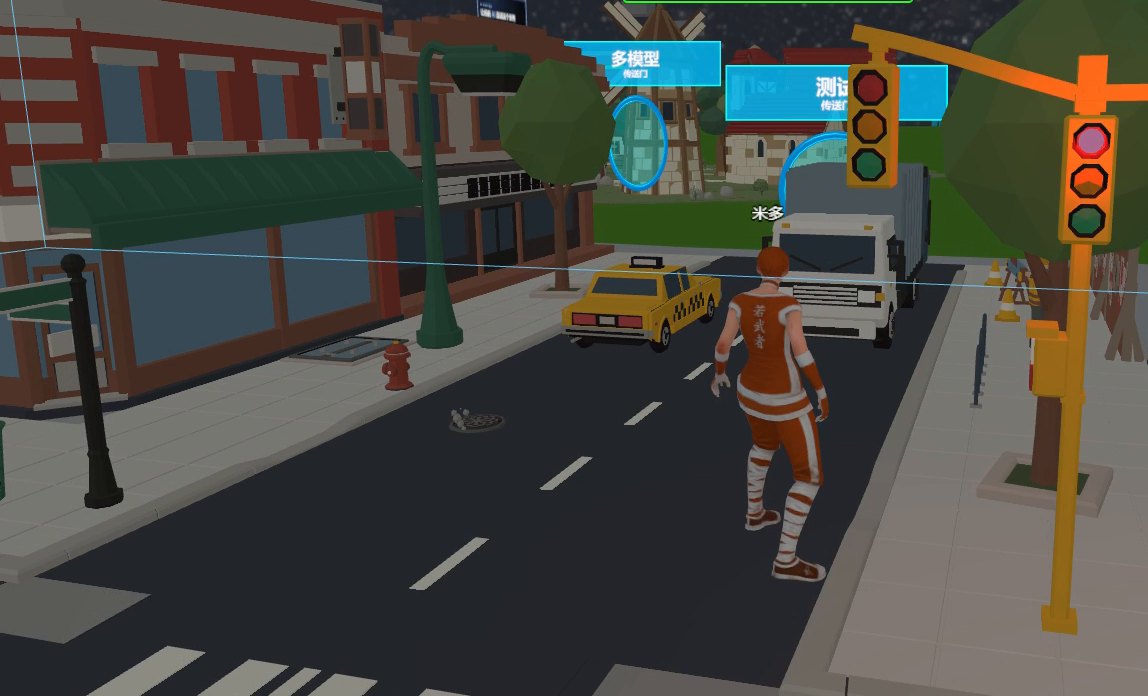
Fig.: A night street inside the browser — brick buildings, lit shopfronts, street lamps, parked vehicles. The scene is not a backdrop; it is a place you can walk through. An online bar usually sits at the end of a street like this.
2. The parts list for one online bar
Break "atmosphere" into objects you can place, and the list turns out to be short. A bar that can open needs about seven things:
| Part | Role | Where it is done |
|---|---|---|
| Street and facade | Tells people where they have arrived | Place models in the editor |
| Counter | Visual anchor and a reason to speak | Model plus one warm point light |
| Booths / small tables | Lets two or three people form a group | Model placement, keep the aisles clear |
| Lighting | Decides whether this is a late-night place or a convenience store | Brightness, range and colour of point lights |
| Sky and time | Night is half the atmosphere | Scene environment settings |
| Music | Fills the silence | External player, or audio inside the scene |
| Greeter | Someone at the door so minute one is not empty | A character: a person, or an AI character |
The light over the counter is the pivotal step. The editor lets you add a model light — a point light whose brightness, range and colour are sliders, with the result visible in the viewport immediately. The same timber stall looks open for business when the light falls on the counter, and looks like a pile of boards when it is switched off. It works the way it does in reality: at night, a shop is recognised by its light.
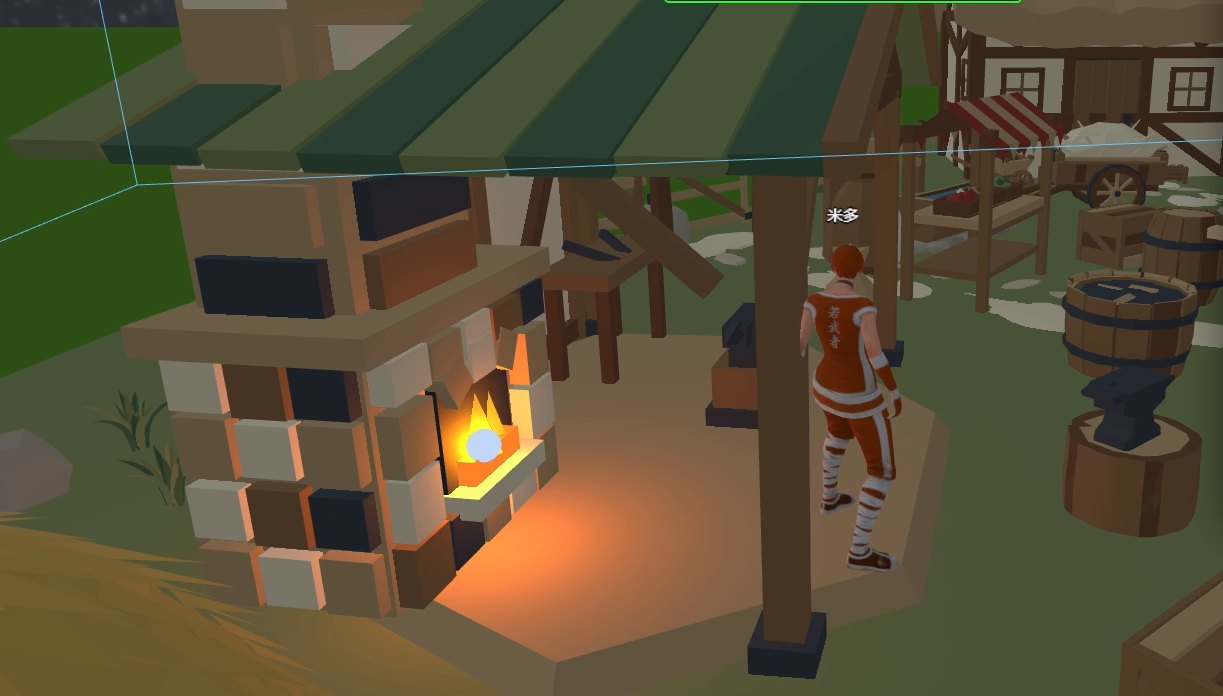
Fig.: A timber stall at night — counter, barrels, one warm hanging lamp, a character standing at the counter. This is the core zone of an online bar. Replace the stall with a counter and the barrels with stools and the method is unchanged.
3. What it cannot do (read this part early)
We do not do marketing copy, so this section comes before the good news.
| Cannot | What actually happens | What to do now |
|---|---|---|
| No built-in voice chat | The platform has no voice calling | Run a voice meeting alongside, on a second screen or a second device |
| Cannot sell alcohol | Selling drinks involves local licensing and age checks | Use it as a venue; keep transactions outside |
| No taste, temperature or smoke | A screen cannot carry those | Accept the boundary |
| A cap on people on screen | More people means lower frame rate; the number depends on model count and devices | Split into sessions or rooms; measure it |
| The AI character will not host for you | It cannot see the rendered scene and does not speak | Treat it as a character standing there, not as staff |
| Phone needs real testing | The same scene runs on a phone, but the feel differs | Walk through it on a real handset before launch |
One more paragraph on the AI part. What we can do: give an agent a domain and a key and it walks into the world as an embodied character. It can move, stop somewhere, and talk in the text channel. But it does not see the rendered image, does not know how many people are at the counter, and does not speak aloud. Treat it as a character fixed near the door. Treat it as a host who welcomes guests and you will be disappointed.
4. Three hosts, three starting points
| Host | The real problem | First move |
|---|---|---|
| Independent musician | Needs a fixed time that is not a gig | One room and one playback spot; skip the whole street |
| Community organiser | Needs a venue that repeats weekly | Facade and living room first, so people can find their way |
| Brand / event team | Needs a reason to be in this place at all | Fix the theme first, then place objects |
Independent musicians do not need a large scene. One room, one corner, one lamp; people come in and stand there listening. The value of that kind of night is not how good the scene looks — it is having a fixed time and a fixed place. The audience knowing that this door opens on Friday at nine matters more than any effect.
Community organisers have to solve wayfinding. People get lost on their first visit, so three things need to be clear: the facade, the path, and one landmark you can remember. None of this needs code, just a walk-through in your head: where would a first-time visitor go?
Brands and event teams should watch one trap: people arrive, and then what. A beautiful empty scene gets a three-minute visit. You need content (a talk, a launch, a person speaking on site) or a mechanism (check-in, collection, a stamp trail), otherwise the venue is just an exhibition hall.
5. What self-hosting means
This runs on your own server, not on an account you rent.
| Item | What it means |
|---|---|
| Where the data is | Your own database and file directories; it does not pass through a third-party platform |
| Will the world close | As long as the server runs, the world runs; there is no platform shutdown |
| What you need | A server that runs Node.js and PostgreSQL, plus a domain |
| Bandwidth | Estimate from concurrent visitors and asset size; measure it yourself |
| Licensing | Networking, commercial use and federation require a subscription license; local use costs nothing |
"The world stays" matters for a night venue: it is not a link, it is an address. Links expire; addresses do not. Next time you open, it is the same place, the furniture has not moved, and returning visitors do not have to learn the layout again.
6. Boundaries, stated once
- We have no online-bar customer case studies. This article describes mechanisms, not a track record.
- We do not take on event production work and we do not send implementation teams. You place the scene yourself, or with someone you hire.
- The phone experience has to be measured on real devices. We cannot promise how it feels on a particular handset.
- Where the platform stands: core features work, but much is unfinished. Our own estimate is that we have covered 5%–8%, with more than ninety percent of the space still ahead (AI world assembly, an agent store and federated AI are all planned). It is not a demo — it runs — but it is far from finished.
7. If your first night is a one-off test
An additive order, smallest first:
- One patch of ground, one lamp, one counter. Confirm that people are willing to stand there.
- Add a facade and a path. So people know where to enter and where to walk.
- Add a second zone (a booth or a back yard). So small groups can spread out.
- Add a greeter character. It solves minute one.
- Add music and a fixed time. That turns a scene into a night venue.
Add one thing at a time and have someone walk through it after each step. What puts people off is rarely the image quality — it is arriving and not knowing what to do.
Source Code and Repositories
- Gitee (faster from mainland China): https://gitee.com/miduoxinxijeji/miduo.git
- GitCode (mirror for mainland China): https://gitcode.com/qq_35054471/virtual-world
- GitHub: https://github.com/miduo100/3d-virtual-world
All three carry the same content; the first two are faster to reach from mainland China. The repositories contain the deployment guide and a demo entry point.
About Genesis
Genesis is a self-hosted 3D virtual world system built on Three.js + WebGL, helping individuals and businesses build their own 3D spaces. Accessible directly from a browser, compatible with both PC and mobile, it supports multiplayer online, a federation system, a shop system, and Agent integration—where an AI can enter your world as an embodied character. Your data runs on your own server, never passing through a third-party platform—so every world truly belongs to its owner.
If you are planning an online night and want to check whether this foundation can hold the venue you have in mind, run it on your own server from the repository instructions — there is no need to talk to us first. > This article describes mechanisms, not a case study. We have no online-bar customer case studies and we do not take on event production work.
This article describes mechanisms, not a case study. We have no online-bar customer case studies and we do not take on event production work.