Online gatherings vanish when the night ends: keep the venue
online gatheringvirtual gathering venue3D virtual spacekeeping a gathering venueself-hosted virtual worldbrowser 3D scenecommunity baseGenesis创世虚拟世界CRM系统
An online gathering usually lives for two hours.
Set a time, send a link, join a room, talk for two hours, leave, and the link stops working. The next day, if you want to continue, everything starts over: a new link, a new room, and the question "where did we leave it".
That is not a people problem, it is a format problem. A video call is an event, not a place. Events end. Places stay.
This article covers three things: why online gatherings disappear when the night ends, what changes when the venue stays, and why an empty venue feels cold — the last of these matters more than the first two.
Who we are: Genesis (创世Genesis, also distributed as 创世虚拟世界CRM系统 — the same self-hosted 3D virtual world product) is a browser-based 3D world foundation on Three.js and WebGL2. The source is available (source-available) and running it locally costs nothing; networking, commercial use and federation require a subscription license.
1. Three reasons gatherings disappear
| Reason | How it shows up | Consequence |
|---|---|---|
| The carrier is a link | A link points at one session; when the session ends it points at nothing | You cannot go back to that place |
| The format is a grid | Avatar tiles have no spatial sense; positions are arbitrary | No memory of "where we sat" |
| The record is a file | Recordings, notes and chat logs sit in a folder | Searchable, but rarely revisited |
The third one gets overlooked. A record is not a place. A two-hour recording you are unlikely to open again; a room that still exists you will return to on some evening without a reason.
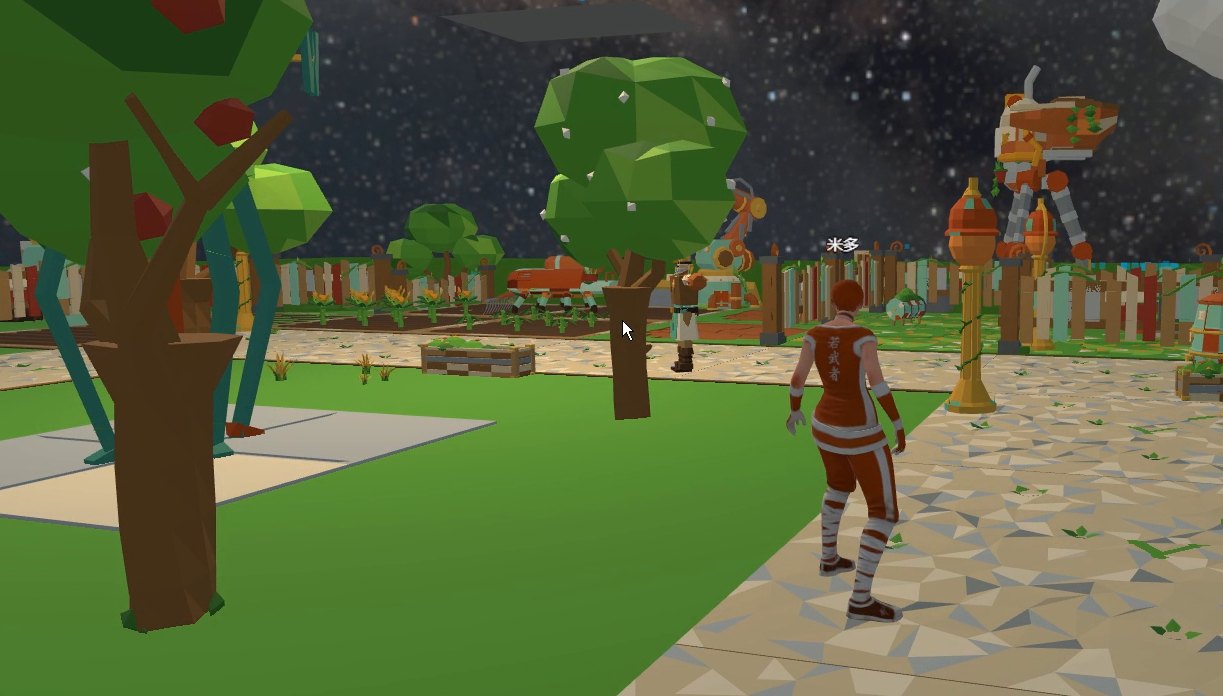
Fig.: A stone-paved plaza under a night sky — flagstones, trees, painted sculptures, timber fences. This is not the backdrop of one meeting; it is a location with edges, an entrance and places to stand.
2. What changes when the venue stays
Swapping an event for a place changes four things.
1. You can go back. If the conversation was unfinished, the next evening you return to the same spot. A call cannot do this, because the room has closed.
2. You can add things. Last time someone said "I will bring the photos"; next time there is a board on the wall. A venue accumulates; a call does not.
3. You can give directions. A third-time visitor says "in through the front, left past the tree". That sentence does not exist in meeting software.
4. You do not explain again. A newcomer asks "what is this place" and the answer is "our plaza", not "I will send you a link".
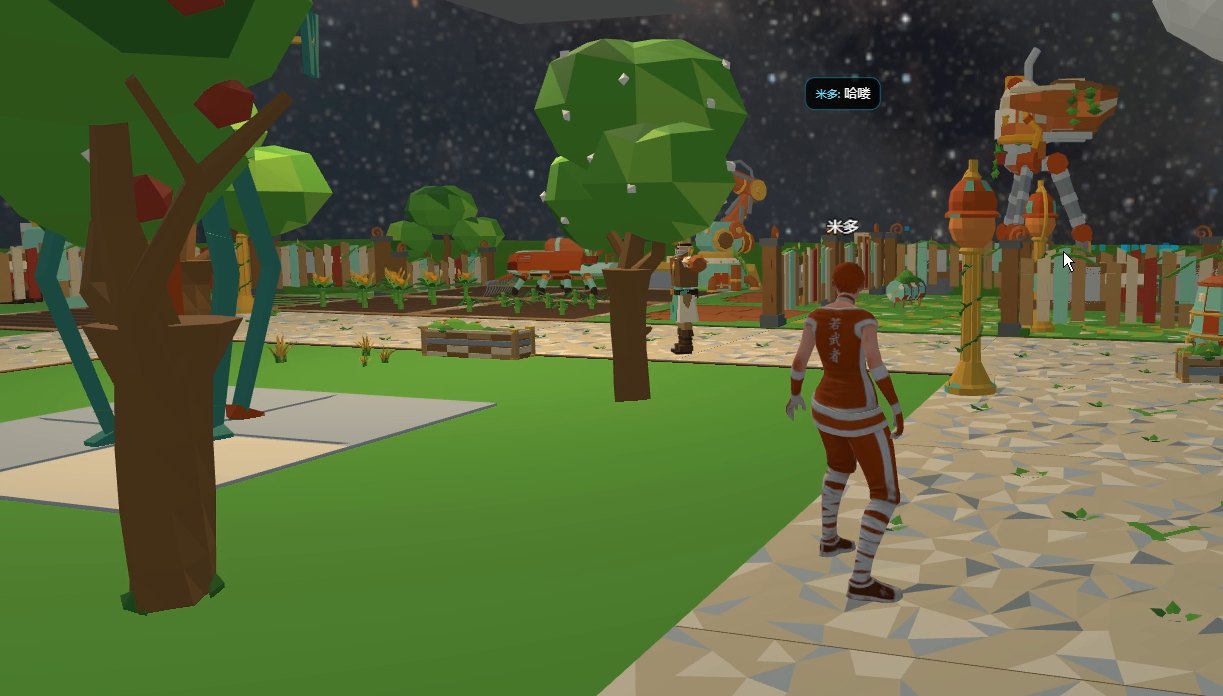
Fig.: The same plaza from another angle — the path narrows into the distance with trees and installations on both sides. Depth decides whether people walk in or crowd at the entrance.
3. Why an empty venue feels cold
This is the least welcome part of the article, but it has to be said.
Keeping a venue does not bring people to it. An empty 3D world is colder than an empty chat group: a group at least holds old messages, an empty world holds grass and you.
In practice, attendance depends on three things, and the venue is one of them.
| Factor | Perceived weight | Note |
|---|---|---|
| Someone invites people | High | Without an invitation, a beautiful venue stays empty |
| A fixed time | High | "Every Thursday evening" beats "you are welcome anytime" |
| How good the venue is | Medium | Decides how long arrivals stay, not whether they arrive |
So the order should be: first a small group of people who will come, then a venue. Done the other way, you pay to build a room nobody enters.
4. Three mechanisms that keep a venue alive
| Mechanism | How | Effect |
|---|---|---|
| Fixed time | Open on the same evening each week | Builds habit; no re-mobilising each time |
| Leaves traces | A board, a wall, one commemorative object | The venue starts to have history |
| A resident character | Someone at the door: a person or an AI character | Solves minute one when there is nobody inside |
The third needs care. We support bringing an AI agent into the world — give it a domain and a key and it walks in as an embodied character, moves around, stops somewhere and speaks in text. But it does not see the rendered scene, does not speak aloud and does not host a knowledge base. A character always near the door is a fair use; expecting it to welcome guests and explain the venue is not.
5. Always-on and on-demand cost differently
A venue that stays open needs a server that stays running. Worth calculating in advance:
| Option | When it fits | Cost |
|---|---|---|
| Always on | Weekly events, a community base | Server and bandwidth billed monthly, running at night too |
| Start and stop | One event a month | Someone has to switch it on and off; easy to forget |
| Local network | Internal demos, your own testing | Not reachable from the internet |
We do not quote prices, because server and bandwidth costs depend on what you buy. What we can say is that this is a recurring cost, not a one-off. Work that number out before committing to a permanent venue.
6. Boundaries, stated once
- We have no online-gathering venue customer case studies. This article describes mechanisms.
- We do not take on event production work and do not send implementation teams.
- The phone experience has to be measured on real devices; do not judge from desktop results.
- Platform status: core features work and the product is still early — our estimate is 5%–8% covered, with more than ninety percent of the space ahead (AI world assembly, an agent store and federated AI are all planned).
- Data lives on your server. That means the world will not vanish because a platform shuts down — and it also means backups, bandwidth and security are yours to manage.
7. If you have already run one gathering
One small thing you can do right away: save the place where the last gathering happened and reuse the same venue.
No new objects needed. Stand where you stood and see whether you remember who was standing where. If you do, the venue exists. If you do not, the space has no memory point yet — add something memorable: a tree, a lamp, a sign.
A venue is confirmed by memory, not by how many polygons it has.
Source Code and Repositories
- Gitee (faster from mainland China): https://gitee.com/miduoxinxijeji/miduo.git
- GitCode (mirror for mainland China): https://gitcode.com/qq_35054471/virtual-world
- GitHub: https://github.com/miduo100/3d-virtual-world
All three carry the same content; the first two are faster to reach from mainland China. The repositories contain the deployment guide and a demo entry point.
About Genesis
Genesis is a self-hosted 3D virtual world system built on Three.js + WebGL, helping individuals and businesses build their own 3D spaces. Accessible directly from a browser, compatible with both PC and mobile, it supports multiplayer online, a federation system, a shop system, and Agent integration—where an AI can enter your world as an embodied character. Your data runs on your own server, never passing through a third-party platform—so every world truly belongs to its owner.
If you have held the same online gathering twice, try turning it into a fixed address instead of a new room each time. > No attendance or activity is promised. A venue is one condition among several; whether people come depends on invitations and timing.
No attendance or activity is promised. A venue is one condition among several; whether people come depends on invitations and timing.