A small island that opens at night: a gathering place of your own
virtual island3D terrain generationonline gathering spaceprivate online spaceself-hosted virtual worldbrowser 3D scenevirtual memorial spaceGenesis创世虚拟世界CRM系统
A public plaza has one problem: it belongs to everyone, so nobody feels it is theirs.
An island that circulates among your own people is different. It is not large — perhaps a ring of grass, a few trees, a wooden house, a pile of firewood — but it has edges. You know when you are on it, and you roughly know who else will be there.
This article covers three things: why edges matter for a gathering, how such an island is built technically, and what it cannot do.
Who we are: Genesis (创世Genesis, also distributed as 创世虚拟世界CRM系统 — the same self-hosted 3D virtual world product) is a browser-based 3D world foundation on Three.js and WebGL2. The source is available (source-available) and running it locally costs nothing; networking, commercial use and federation require a subscription license.
1. Edges are a social design decision
Put a group of people on a large plaza and on a small island, and they behave differently.
| Venue shape | Behaviour | Fits |
|---|---|---|
| Large plaza / public space | Gather near the entrance, look around, leave | Exhibitions, launches, one-off events |
| An island with edges | Walk inward, sit down, stay longer | A fixed small circle, weekly gatherings |
| A single room | Talk face to face, sound stays in | Groups of six or fewer |
The difference is how long it took to arrive. Walking somewhere filters people. Opening a link into a meeting room and walking onto an island carry different psychological costs; the second feels more like keeping an appointment.
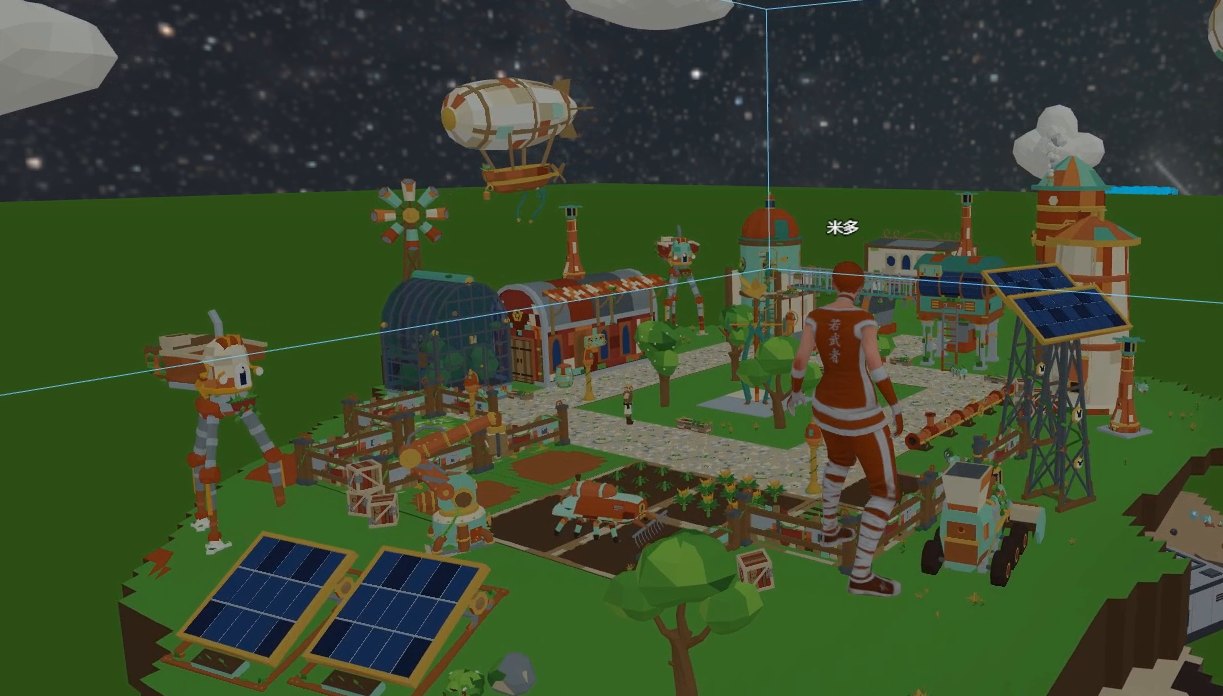
Fig.: A small island floating in a starry sky — grass, a few painted houses, solar panels, balloons. It is not large and its edges are clear. That sense of the whole patch belonging to you is what separates it from a public scene.
2. How an island is built
This foundation generates terrain; it does not just drop a house on a flat plane. Terrain comes from a height field built by layering two kinds of noise — one for broad relief, one for ridges — which produces mountains, valleys and slopes.
| Parameter | What it does | Visible effect |
|---|---|---|
| Height field (fbm + ridged) | Shapes the mountains and their direction | The same parameters can produce an island, hills or a coastline |
| Vertex colour blending | Blends grass, soil, rock, snow and sand by height and slope | Grass at the foot, exposed rock on steep faces, snow on top |
| Snow line / tree line | Switches material once a height is passed | High ground turns white without hand painting |
| Lake level | Fills anything below a set height | Lakes appear in valleys on their own |
| Flatten radius | Levels the ground around a point | Gives houses, fires and plazas somewhere to stand |
| Edge mode | How the island ends | Ridge, sea, cliff, or left alone |
| Chunked LOD | Lower detail for distant chunks | Frame rate does not keep dropping as you walk |
The flatten radius matters most for an island. Generated terrain undulates, so you cannot put a wooden house straight onto a slope: pick a point, level the ground within a radius, then place objects, and the house stands properly. That step is what separates "terrain generation" from "a place where people can gather".
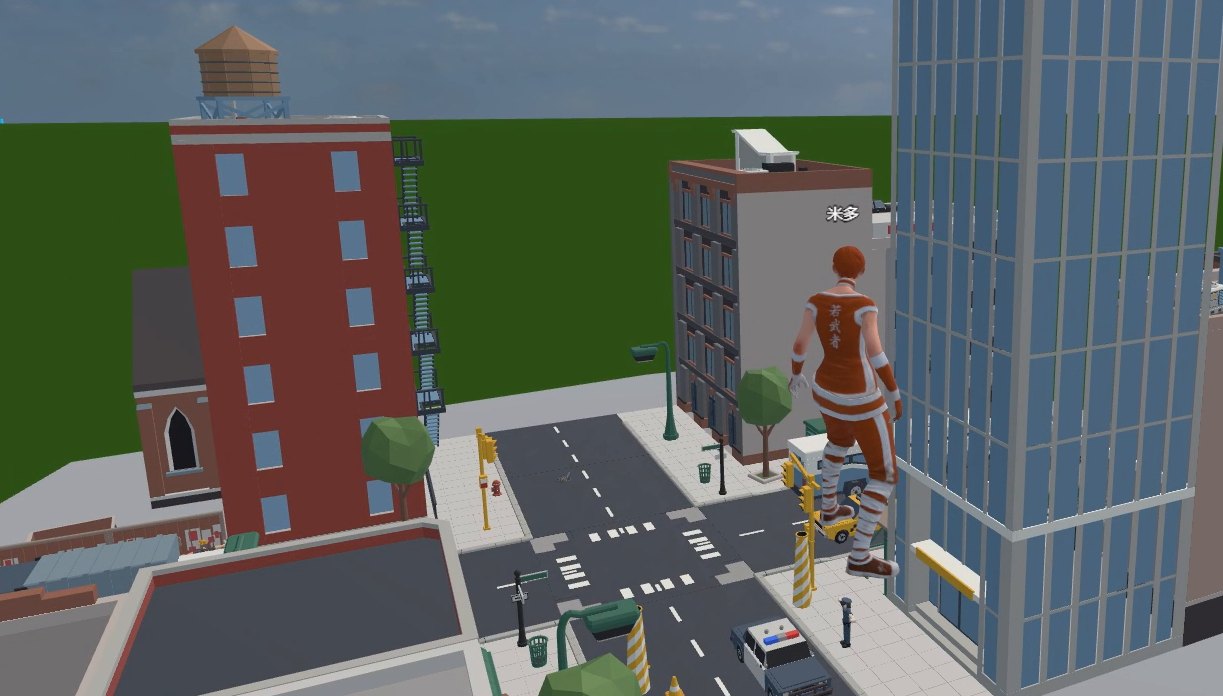
Fig.: A street corner at dusk with a brick block next to a glass tower. It is here to make the point that an island is not the sole option — put the venue on an urban street and guests still know which street they are on. The sense of edges works the same way.
3. What the terrain cannot do
| Cannot | Reality |
|---|---|
| No caves | This is a 2.5D height field: it rises and falls, it cannot be hollowed out |
| Terrain does not conform to buildings | Houses sit on levelled ground rather than being cut into the hillside |
| No live shape editing | Changing terrain means regenerating with new parameters, not painting by hand |
| Trees and grass are placed, not grown | Vegetation is model placement, not scattered automatically by terrain |
| Phone performance needs measuring | Chunked terrain on a handset depends on the device |
We write this down because many people expect procedural terrain to behave like a block-building game where you dig and modify freely. This is not that. It can generate a good-looking mountain, but it will not let you go inside it.
4. What happens on the island
| Activity | What to place | Ground needed |
|---|---|---|
| Fireside conversation | Fire, ring of seats, night sky | One levelled patch of grass |
| Camping (conceptually) | Tent, string lights, a few light sources | Gentle slope, away from a cliff edge |
| Stargazing | As few ground lights as possible | High ground away from bright areas |
| Anniversary | A board, a few lamps, one fixed spot | A small platform that holds people |
| Small review meeting | A long table and seats | Indoors or under a shelter |
The anniversary use deserves a note. A digital memorial space is another line we have written about; its core is not reconstruction but having somewhere to return to. An island suits it: small, edged, opening on the same day each year.
One thing must be stated clearly: we do not use words like resurrection, rebirth or digital immortality. A space is a space. It holds the people who remember, not the person being remembered.
5. Why self-hosting
An island that stays yours presupposes it does not sit on someone else's platform.
| Item | Self-hosted situation |
|---|---|
| Data | In your own database |
| World | As long as the server runs, the world runs |
| Access | Your own domain; you decide who gets it |
| Cost | Server plus bandwidth, monthly |
| Responsibility | Backups, security and updates are yours |
The cost is real: no support desk restarts it for you, and nobody reads the logs for you. The good news is that deployment is ordinary — Node.js and PostgreSQL, and one cloud host is enough to start.
6. Boundaries, stated once
- We have no island-gathering customer case studies.
- We do not take on scene production work and do not send implementation teams.
- The phone experience has to be measured on real devices.
- Platform status: core features work and the product is still early. Our own estimate is 5%–8% covered, with more than ninety percent of the space ahead (AI world assembly, an agent store and federated AI are all planned).
- If you bring an AI character onto the island: it can walk, stop somewhere and speak in text, but it does not see the rendered scene, does not speak aloud and does not host a knowledge base.
7. Start with one levelled patch of grass
Do not start by thinking "island". Cut the order down to four steps:
- Generate terrain and pick an edge mode (ridge or sea).
- Find a spot to level; the radius does not need to be large, enough for one house and one fire.
- Place a house, a pile of firewood and a few lamps.
- Turn on the night sky and walk in for a minute.
If you want to stay a little longer during that minute, the island exists.
Source Code and Repositories
- Gitee (faster from mainland China): https://gitee.com/miduoxinxijeji/miduo.git
- GitCode (mirror for mainland China): https://gitcode.com/qq_35054471/virtual-world
- GitHub: https://github.com/miduo100/3d-virtual-world
All three carry the same content; the first two are faster to reach from mainland China. The repositories contain the deployment guide and a demo entry point.
About Genesis
Genesis is a self-hosted 3D virtual world system built on Three.js + WebGL, helping individuals and businesses build their own 3D spaces. Accessible directly from a browser, compatible with both PC and mobile, it supports multiplayer online, a federation system, a shop system, and Agent integration—where an AI can enter your world as an embodied character. Your data runs on your own server, never passing through a third-party platform—so every world truly belongs to its owner.
If you want to see what this terrain generation looks like, run a copy on your own server and change a few parameters to watch the mountain change. > This article describes platform mechanisms, not a performance promise. We have no island-gathering customer case studies and we do not take on scene production work.
This article describes platform mechanisms, not a performance promise. We have no island-gathering customer case studies and we do not take on scene production work.