Online private rooms: an undisturbed room for a small gathering
online private roomvirtual roomsmall online gathering3D interior spaceself-hosted virtual worldbrowser 3D sceneonline birthday partyGenesis创世虚拟世界CRM系统
Not every gathering needs a plaza.
A birthday for six, an anniversary for two, a reading group, a project review — these need a room you can close the door on, not open space. With few people, a larger space gets more awkward: sound scatters, attention scatters, and nobody wants to speak first.
This article is about the online private room: why small spaces are harder than they look, what three things a room needs, how you control who gets in, and what it cannot do.
Who we are: Genesis (创世Genesis, also distributed as 创世虚拟世界CRM系统 — the same self-hosted 3D virtual world product) is a browser-based 3D world foundation on Three.js and WebGL2. The source is available (source-available) and running it locally costs nothing; networking, commercial use and federation require a subscription license.
1. Big spaces are for events, small spaces are for relationships
| Occasion | People | Space needed | What goes wrong |
|---|---|---|---|
| Launch / exhibition | Dozens or more | Open, with a route | Too crowded to move |
| Bonfire night / plaza gathering | 8–25 | A centre and a ring | No clear centre, people drift |
| Private room / small gathering | 2–8 | Walls, a table, a door that closes | Too empty, conversation dies |
The third row is the core: the enemy of a small gathering is not a lack of excitement, it is emptiness. Six people on a plaza drift apart without noticing; six people around a table start talking.
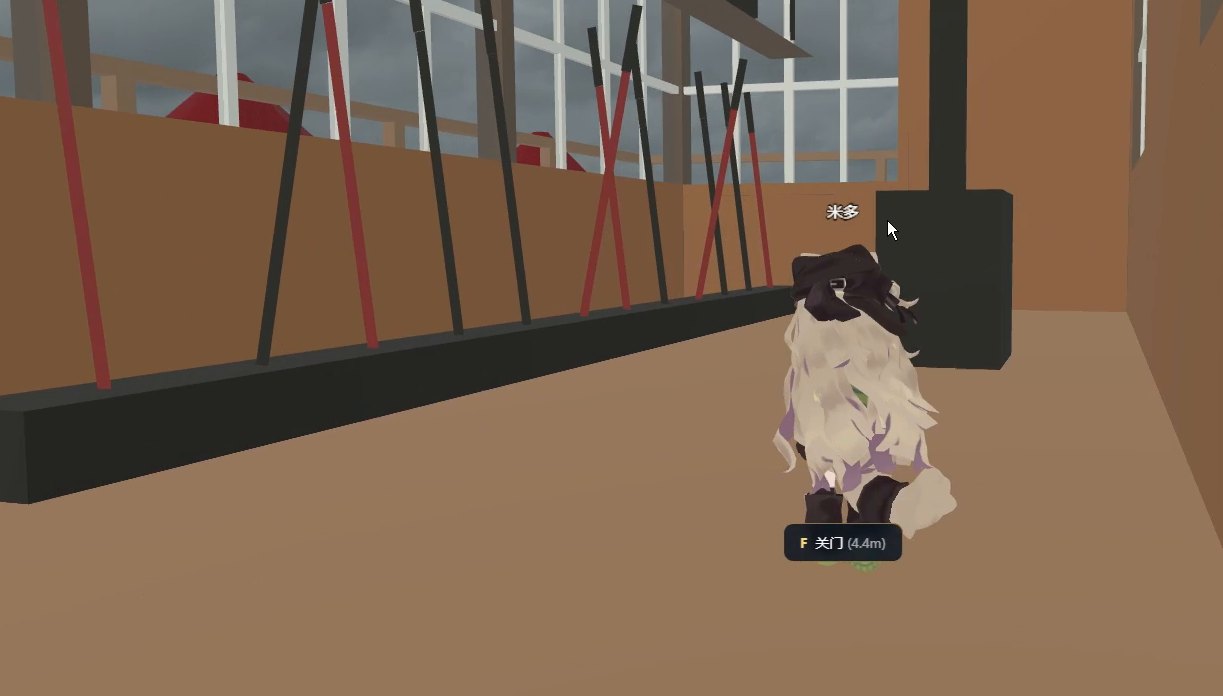
Fig.: An interior room — wooden floor, white walls, slanted windows, railings. It is not large, but the walls are real walls: close the door and the noise of the plaza stays outside.
2. A room needs three things
| Element | How it is done in 3D | Role |
|---|---|---|
| Wall | A solid or half-height wall separating inside from outside | Blocks sight and movement, creates an inside |
| Door | An opening, or a door leaf that can close | Decides who enters, and when |
| Table | A table with several places to sit | Gives every eye one place to land |
The table matters more than the chairs. When people sit, their gaze settles on the middle of the table; whatever sits there — a lamp, a book, a cake model — becomes the focus of the gathering. Standing on open ground, attention scatters; around a table it has somewhere to rest.
Half walls are worth trying: a fully closed wall feels pressured, a half wall lets you see out while keeping you in. That sits between a private room and a terrace, useful when the occasion should not feel too formal.
3. Who gets in
In practice, the question for an online private room is access control. There are three approaches here, ordered by strictness:
| Approach | How | Fits |
|---|---|---|
| An undisclosed world | The address is known to you; you send it to whoever should come | Small gatherings among friends |
| Accounts and permissions | Sign-in required, accounts created or approved by you | Events with a guest list |
| Cross-world links with confirmation | Arriving from another world via a link triggers a confirmation | Guided entry in a federation setup |
The third one is worth explaining: a cross-world jump does not drag someone's character over; it asks them to confirm first. That confirmation is a product decision, not a technical limit — moving a person from their own world into someone else's deserves one "do you want to go?" in between.
Beyond access control there is capacity: the number of places in the room. Place eight seats and twelve arrivals will be standing. That is not a system limit; it is what you decided while placing furniture.
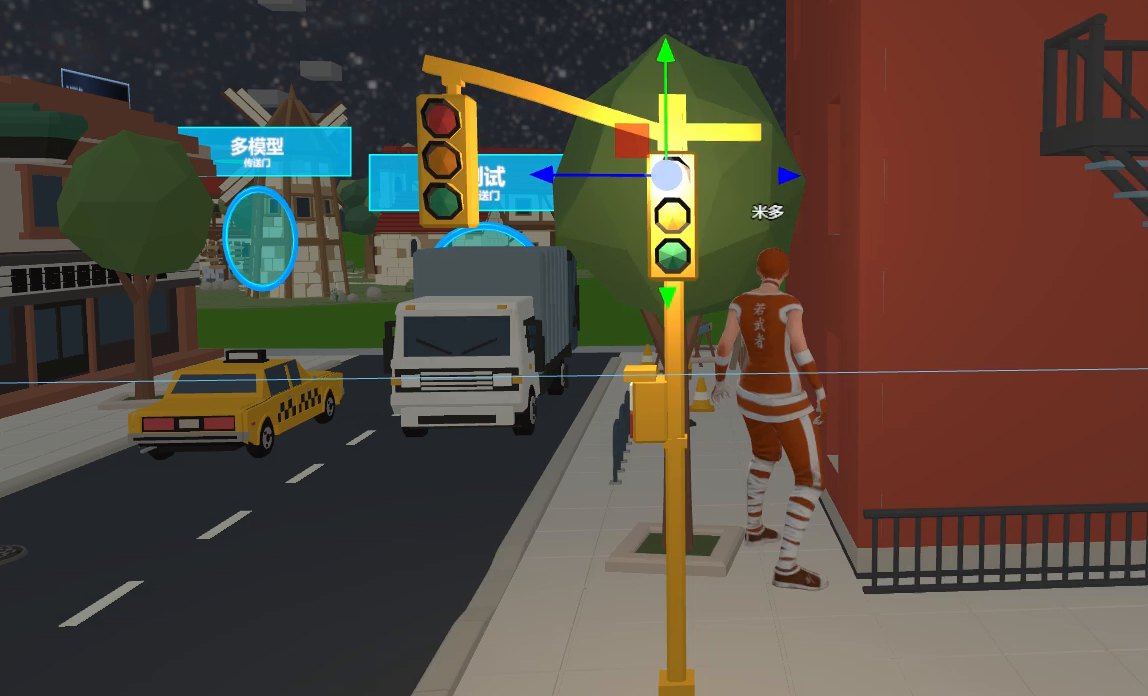
Fig.: Shopfronts at night. It is here to make a point about private rooms: a room also needs a street outside. People wait by the door as they arrive and walk out through it when the evening ends. Without an outside, a private room is a box that appears and disappears.
4. Four occasions that suit a private room
| Occasion | What to emphasise | Suggested length |
|---|---|---|
| Birthday | A board people can write on, a few bright objects, one main lamp | 60–90 minutes |
| Anniversary | As few light sources as possible, one fixed spot, one meaningful object | 30–60 minutes |
| Reading group | A long table, seats around it, one light focused on the table | 90 minutes |
| Project review | A wall area for conclusions, room to stand by the table | 60 minutes |
On anniversaries: we have written separately about digital memorial spaces. The same principle applies to a private room — no promise of reconstruction, no promise of resurrection, just a place you can return to for a while. That boundary has to hold, otherwise you are selling someone's grief as a feature.
5. What it cannot do
| Cannot | Situation | What to do now |
|---|---|---|
| No built-in voice chat | There is no voice calling in the platform | Run a voice meeting alongside; small rooms make this easier |
| No gifts, tips or raffles | There are no built-in event functions of that kind | Keep them outside, or do without |
| Seats are not reserved | People walk to a place rather than being assigned one | Guide with layout instead of enforcing |
| The AI character cannot host | It cannot see the scene and does not speak | The host is a real person |
| Phones need measuring | Turning the camera is harder on a small screen | Walk through it on a real handset before launch |
6. Boundaries, stated once
- We have no online private room customer case studies. This article describes mechanisms and layout reasoning.
- We do not take on scene production work and do not send implementation teams.
- The phone experience has to be measured on real devices.
- Platform status: core features work and the product is still early. Our estimate is 5%–8% covered, with more than ninety percent of the space ahead (AI world assembly, an agent store and federated AI are all planned).
- Data sits on your server: the world will not be shut down by a platform, and backups are yours to run.
7. The build order for one room
- Place four walls and leave a doorway.
- Put in a table with four to eight seats.
- One main lamp, dim enough that faces are readable and no more.
- Put a few things outside the door — a street lamp, a sign — so an outside exists.
- Invite six people, fix a time, run a voice meeting alongside.
- Sit at the table yourself and speak first.
There is one test for whether a room works: once the door is closed, does somebody want to speak first.
Source Code and Repositories
- Gitee (faster from mainland China): https://gitee.com/miduoxinxijeji/miduo.git
- GitCode (mirror for mainland China): https://gitcode.com/qq_35054471/virtual-world
- GitHub: https://github.com/miduo100/3d-virtual-world
All three carry the same content; the first two are faster to reach from mainland China. The repositories contain the deployment guide and a demo entry point.
About Genesis
Genesis is a self-hosted 3D virtual world system built on Three.js + WebGL, helping individuals and businesses build their own 3D spaces. Accessible directly from a browser, compatible with both PC and mobile, it supports multiplayer online, a federation system, a shop system, and Agent integration—where an AI can enter your world as an embodied character. Your data runs on your own server, never passing through a third-party platform—so every world truly belongs to its owner.
If you are hosting six people, set up one room before considering a larger venue. > This article describes layout reasoning and platform mechanisms, not a performance promise. We have no online private room customer case studies and we do not take on scene production work.
This article describes layout reasoning and platform mechanisms, not a performance promise. We have no online private room customer case studies and we do not take on scene production work.