Where Do the Models, Textures and HDRIs Come From? Handling Asset Licensing in a 3D World
3D model licensingcommercial use of 3D assetsGLB copyrightHDRI licenceasset provenance in a virtual worldasset registerdigital exhibition asset complianceGenesisChuangshi Virtual World CRM
Once a 3D world is up, people ask a lot of technical questions. Very few ask the one that actually causes damage: where did all these models, textures, sky maps and audio come from, and were you allowed to use them that way.
A technical mistake can be fixed by editing code. An asset problem cannot — the file is already on the client's server.
A note on identity first: Genesis (also known as Chuangshi Virtual World CRM — the same self-hosted 3D world product) is a browser-based 3D world foundation built on Three.js and WebGL2. You open a page and you are inside. The source is available (source-available); running it locally costs nothing; networked, commercial and federation use require a subscription license. We do not supply an asset library. This article is about keeping track of where assets come from.
1. Every object in the scene is a file
Standing in the world, you see a building, a street lamp, a lawn. Inside the editor it looks completely different.
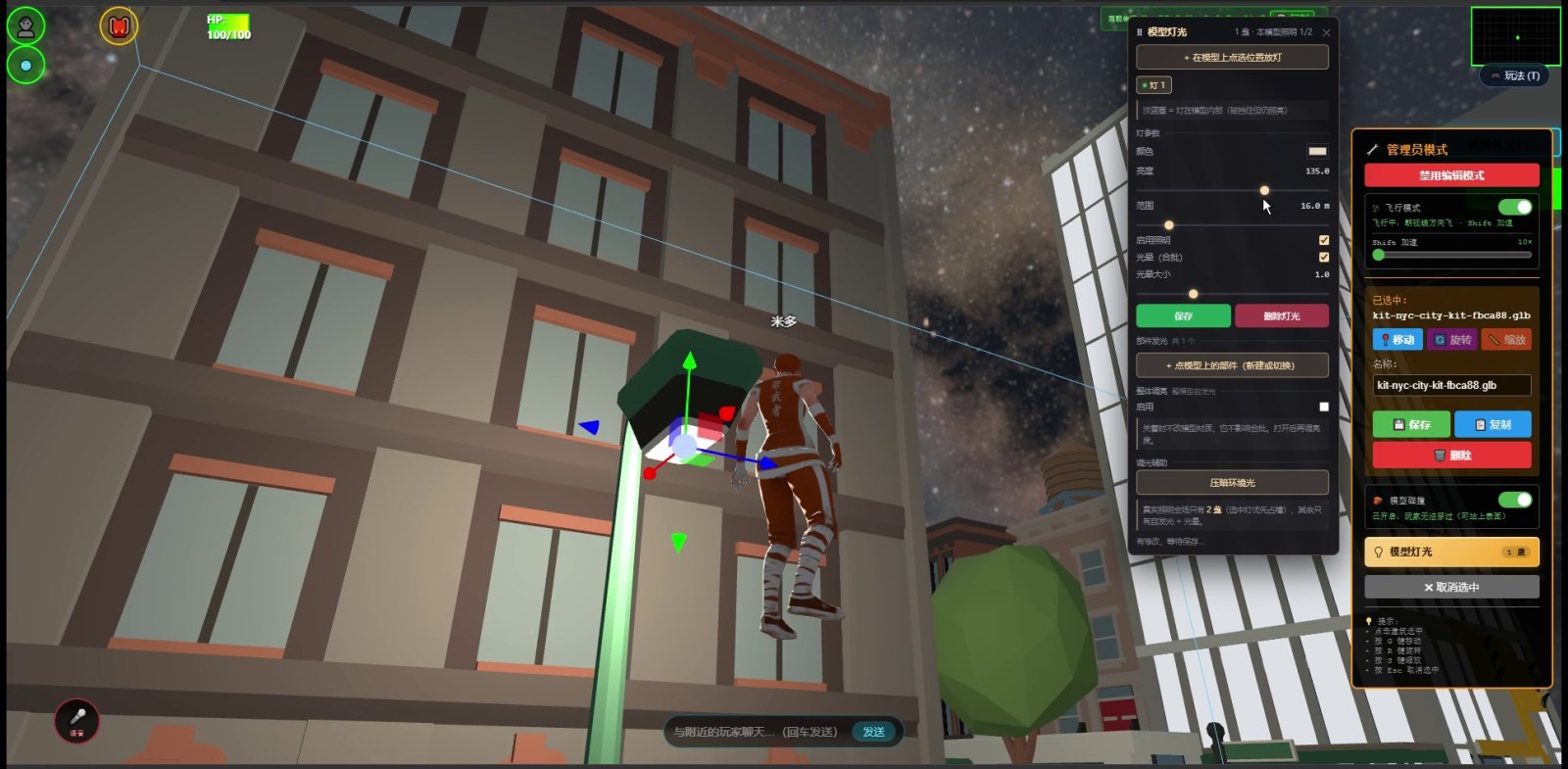
The screenshot above shows a street lamp opened in admin mode. The panel on the right lists the model file it maps to (kit nyc-city-kit-....glb), next to the replace, scale and delete actions. You are not clicking a street lamp. You are clicking a specific file.
| What you see in the scene | What actually exists | Where it usually comes from |
|---|---|---|
| A building, a lamp, a table | One GLB model | Built in-house, asset kit, scan, AI generated |
| Brick pattern on a wall | A texture (PNG / JPG) | Shipped with the kit, texture site, your own photo |
| Sky light and metal reflections | An HDR environment map | Asset kit, HDR site |
| Colour gradient on the ground | Vertex colours or a texture | Painted on during modelling |
| Background music and sound effects | Audio files | Music library, sound pack |
The point of this table: none of it grew out of your world on its own. Each item came from someone, and that someone may or may not have granted permission.
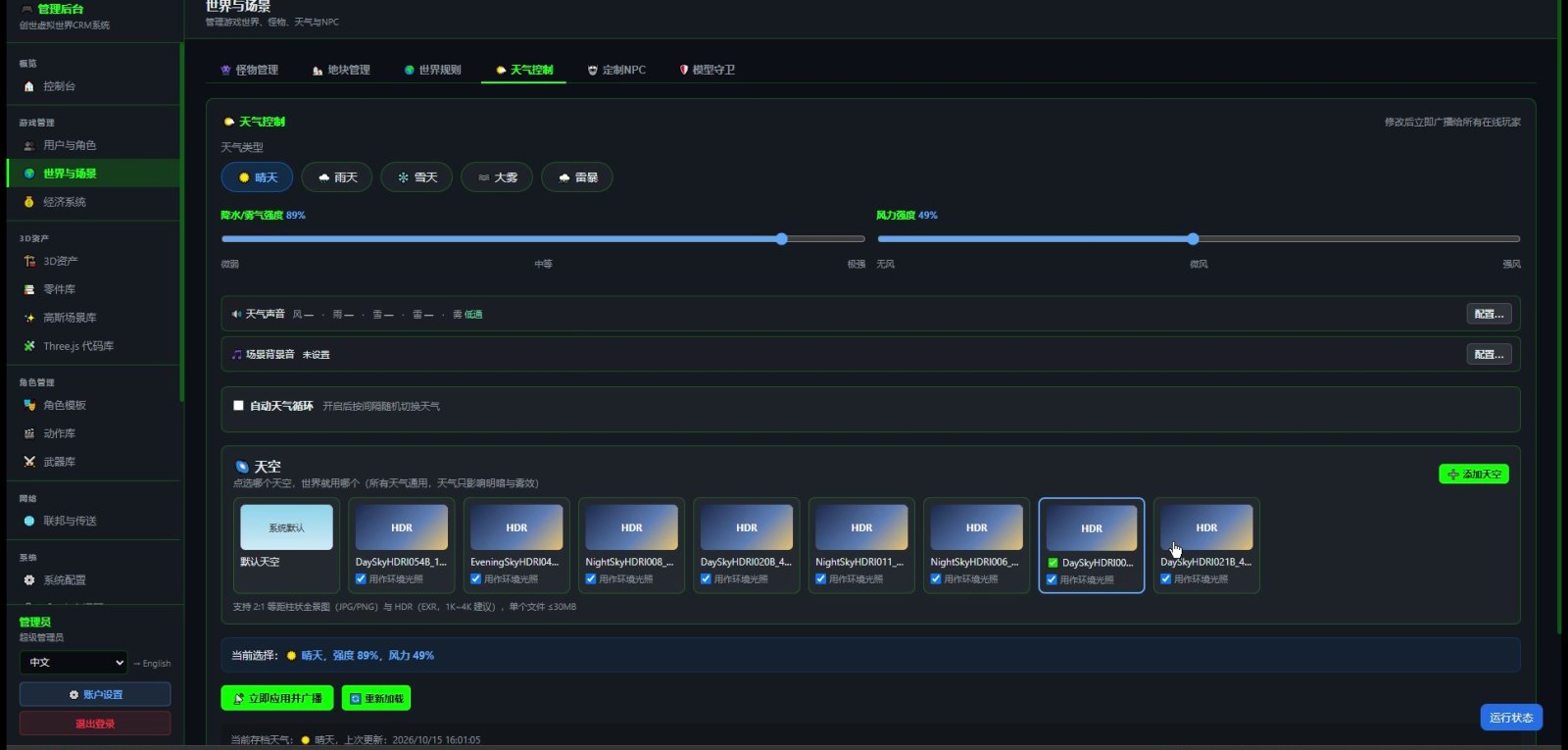
The second screenshot is the environment lighting panel in the admin area — a row of HDR sky maps, ticked to enable, twelve files in total. Even the sky is an asset. This layer is easy to miss because it is not as visible as a model.
2. Four sources, four licensing situations
| Source | Typical practice | What the licence turns on | Where it goes wrong |
|---|---|---|---|
| Built in-house | Modelled from scratch, e.g. in Blender | Who made it, and whether an ownership clause was signed | Models made by contractors may not belong to you |
| Asset kits and model stores | Buy a kit, or download a free pack | Licence tiers: personal / commercial / redistribution with a product | Treating a free download as commercial use |
| Scanning | Photogrammetry, laser, Gaussian splatting | Whose object was scanned, and whether the scanner had permission | Museums hold rights over digitised collections; buildings carry property and design rights |
| AI generation | Image-to-3D, text-to-3D | Whether the platform terms allow commercial use, and who owns the output | Topology and UVs usually need manual rework |
All four routes work. The cost is not money, it is the number of things you must confirm: ownership for in-house work, the full licence for a purchased kit, permission for whatever you scanned, and the platform terms for AI output.
3. "Free to download" and "free to use commercially" are different
This is where it usually goes wrong. Some model-sharing sites state it plainly: copyright in the work is held jointly by the site and the author, and reproduction, publication or distribution in any form is prohibited. Free download means just this: you may download the file.
That implies three things:
- Downloading it for yourself to look at is usually fine.
- Putting it into a world you deliver to a client may not be permitted by that site's terms.
- Changing the text on the model and using it anyway does not get around the adaptation right.
The test is not whether you paid. The test is which tier of licence you hold. A paid kit may still be limited to your own projects and forbid redistribution with a product.
4. Self-hosting adds a layer: the models travel with the world
On a rental platform the models sit on the platform's servers and users simply visit. Self-hosting is different: you hand the program and the world over to the client's machine, and the model files go with it.
So that line in an asset licence saying "for your own project alone" has to be read again in your context. Kit licences usually come in one of three shapes:
| Licence wording | Usable when delivering a self-hosted world? |
|---|---|
| Commercial use permitted, may be distributed with the product | Yes, keep the licence record |
| Personal or internal use | No, cannot go into a world delivered to a client |
| Redistribution of the model files themselves prohibited | Yes inside the product, but not as a bare model pack |
The third shape is the common one: the models may appear inside your work, but may not be handed over as a model library. Delivering a whole world and shipping the asset folder as a gift are two different acts. Draw that line in both the folder structure and the contract.
5. One asset register beats any assurance
Keeping track of provenance does not need a legal team. It needs one table. Every time a model, a track or an HDRI goes in, add a row:
| Field | What to record | Example |
|---|---|---|
| File name | The name inside the world | lamp-street-01.glb |
| Source | Who supplied it, where it was downloaded, order number | Kit A / built in-house / AI tool B |
| Licence type | Personal / commercial / distributable with product | Commercial, distributable |
| Proof | Screenshot, order, archived licence page | Stored in the same folder |
| Expiry | Whether a subscription licence lapses | None / a given month |
The table does not need to be sophisticated. It needs to answer "where did this come from and who allowed it". Its real value shows up two years later, when you have forgotten where that lamp came from.
The "AI description" field on each model in the editor is a reasonable place to note the source in one line: "Source: kit A, commercial licence". This is a habit problem, not a tooling problem.
6. Music and sound effects are a separate trap
Models leave a file you can inspect. Music is easier to overlook. Three questions first:
- Is the track licensed for personal or commercial use?
- Does a shared online space where several people can be present at once count as public playback?
- Does the sound pack allow inclusion in a product?
None of these has a universal answer; it depends on the specific licence. An audio file whose origin you cannot trace should be treated as unusable.
7. What it cannot do
| Not available | Situation | What to do now |
|---|---|---|
| No asset library | The platform ships no models, textures or music | Find, build or buy your own |
| No licence review | We do not judge whether a given asset is usable | Read the terms yourself, or ask a lawyer |
| No legal opinion | This is an engineering view, not legal advice | Consult a professional when it matters |
| No copyright detection | Nothing scans models for provenance | Rely on the register |
| No negotiation on your behalf | Talking to rights holders is your job | Contact the author or the site directly |
8. The boundaries, stated once
- We have no asset-licensing customer case studies. This article describes process and decision criteria.
- We do not send implementation teams, and we do not take on scene production.
- The phone experience has to be measured on real devices.
- Status: the core features work, the foundation as a whole is still early. Our own estimate is that we have covered 5%–8% of it, with more than ninety percent of the space still ahead (AI-assembled worlds, an Agent store and federation AI are all planned).
- Your data stays on your own server: so do the assets. Nobody but you can keep their provenance straight.
9. Questions that come up
If I model it myself in Blender, is there no copyright issue?
Ownership is usually fine. Two things to watch: models made by contractors or freelancers depend on what the contract says, and a model built to look like a character or logo from an existing property is yours while the intellectual property is not.
Can AI-generated models be used commercially?
Not as a blanket answer. Read the generator's terms first — some paid tiers allow commercial use and free tiers do not — then look at the output itself: topology, UVs and textures often need rework, and usability depends on how much you are willing to fix.
Can a purchased kit go into a world I deliver to a client?
Check whether the licence includes distribution with a product. If that clause is missing, treat it as not allowed, even though you paid for the kit.
Who holds the rights to a scanned museum object?
The object itself may carry no copyright, but the institution usually has terms covering its digitised record, and the scanner needs permission to capture it. If you want to use it, talk to the institution rather than picking up a model of unknown origin from an asset site.
Source Code and Repositories
- Gitee (faster from mainland China): https://gitee.com/miduoxinxijeji/miduo.git
- GitCode (mirror for mainland China): https://gitcode.com/qq_35054471/virtual-world
- GitHub: https://github.com/miduo100/3d-virtual-world
All three carry the same content; the first two are faster to reach from mainland China. The repositories contain the deployment guide and a demo entry point.
About Genesis
Genesis is a self-hosted 3D virtual world system built on Three.js + WebGL, helping individuals and businesses build their own 3D spaces. Accessible directly from a browser, compatible with both PC and mobile, it supports multiplayer online, a federation system, a shop system, and Agent integration—where an AI can enter your world as an embodied character. Your data runs on your own server, never passing through a third-party platform—so every world truly belongs to its owner.
Sort out provenance before putting things into the world. A file is easy to swap; a world already delivered is not. > This article discusses asset provenance and licence judgement from an engineering perspective. It is not legal advice. We have no asset-licensing customer case studies, and we do not provide asset libraries or licence review.
This article discusses asset provenance and licence judgement from an engineering perspective. It is not legal advice. We have no asset-licensing customer case studies, and we do not provide asset libraries or licence review.